We earn a commission if you buy through our links, at no extra cost to you.
Best Security Camera for a Driveway at Night
How to cover a driveway and a parked car after dark: distance, mounting height, floodlights vs. infrared, plate limits, power and neighbor privacy, plus four models.
At a glance
For a driveway, the Ring Floodlight Cam 4K Pro adds 2,000-lumen floodlights where a fixture is already wired. The eufyCam S3 Pro 2-Cam Kit runs on solar with local storage, and the Reolink RLK8-811B4 suits a long drive with 5X optical zoom. Do not count on reading plates at night.


A driveway is a harder camera job than a front door. The subject is farther away, the light is poor, cars arrive with headlights that blind a lens, and the view usually points toward a street or a neighbor. A camera that looks fine on a spec sheet can still produce a gray blur of a car at 11 p.m. This guide covers what actually decides the result: distance, mounting, light, power and privacy. It then matches four models from our best security cameras of 2026 ranking to different driveways.
We do not run our own measurements. Specifications below come from the manufacturers’ pages, and we name the source for each figure. Where a brand gives no number, we say so.
Start With Distance and Field of View
Measure from the spot where you would mount the camera to the farthest place you care about, usually the end of the driveway or the back bumper of a parked car. Then compare that number to what each camera is built to cover.
The published figures differ widely:
- Ring Floodlight Cam 4K Pro: 140 degrees horizontal by 85 degrees vertical for the camera, with floodlights that reach up to 65 feet, according to Ring.
- eufyCam S3 Pro: 135 degrees diagonal (112 horizontal, 60 vertical), radar-assisted motion detection up to 40 feet and infrared illumination up to 32.8 feet, according to eufy.
- Reolink RLK8-811B4 cameras: a 5X motorized optical zoom that narrows the view from about 105 degrees horizontal at the wide end to 31 degrees, and infrared up to 98 feet (30 meters), according to Reolink.
- Google Nest Cam Outdoor (Wired, 2nd Gen): 152 degrees diagonal with night vision up to 20 feet, according to Google.
A wide view shows more of the yard, but every object gets smaller. A 152-degree lens sees a lot of driveway, yet a person at 40 feet fills only a sliver of the frame. A narrower view or optical zoom keeps more pixels on the thing you want. For a short, wide apron in front of a garage, wide is fine. For a long drive, zoom matters more than megapixels on paper.
Mounting Height and Angle
Most people mount too high and too far back. Some practical rules:
- Eight to ten feet is a common range. That is high enough to be hard to grab and low enough to see faces rather than the tops of heads. Going higher shrinks detail on people.
- Angle the lens down slightly. A camera pointed level at a long driveway fills the top half of the picture with sky and trees, which also confuses motion detection.
- Mount the camera at the corner of the garage or eave, aimed along the drive. Looking along the length of a driveway puts approaching cars and people head-on, while looking across it shows them as a quick side-on blur.
- Keep it off the headlight path. If your own cars or a neighbor’s headlights hit the lens at night, the image blooms white. Move the camera a few feet or add a shade.
- Add a second camera for a big property. One camera for the garage door and one covering the street end gives better detail than a single camera trying to do both.
Floodlights vs. Infrared at Night
Two lighting approaches dominate:
Floodlights and spotlights let the camera record color. Ring lists two motion-activated 2,000-lumen floodlights at 3000K, and Reolink lists five spotlights at 450 lumens for its kit cameras. Light also deters. A sudden floodlight on a stranger by a car is a stronger message than a silent camera.
Infrared is invisible. Cameras use 850 nm LEDs to light the scene in black and white. It is the gentler choice if a floodlight would shine into a bedroom next door. Reolink notes the spotlight on its cameras can be dimmed or turned off, and eufy says its MaxColor mode can produce color images without a spotlight, with infrared as the fallback in full darkness.
Which is better depends on the lot. If there is already a floodlight on the garage, a camera built into that fixture is easy to justify. If you live close to neighbors, use infrared or a dimmed light and aim it at your own pavement.
Vehicle Detection and False Alerts
Driveways create endless false alerts: headlights sweeping across the lens, a branch in the wind, a cat, the neighbor’s car backing out. Features that help:
- Person and vehicle detection. Ring says person and vehicle detection requires a compatible Ring subscription. eufy lists stranger, human, vehicle and car events on its smart alerts, and Reolink lists person, vehicle and animal detection with no monthly alert fee.
- Radar plus passive infrared. eufy pairs radar detection up to 40 feet with PIR to filter out false alerts.
- Activity or motion zones. Draw the zone around your own driveway and exclude the street. Ring lists customizable camera motion zones and 3D motion detection.
Expect to tune the zones for a week or so after installation. Reducing the zone is nearly always better than lowering sensitivity everywhere.
License Plates: What Cameras Can and Cannot Do
Many buyers want a plate number. Most consumer cameras are poor at it after dark, and it is better to know that before you buy.
Reolink, a camera maker with its own interest in the subject, says general security cameras with strong zoom read plates reliably within roughly 15 to 50 feet, and that beyond that only dedicated license plate recognition hardware stays consistent. It also says plates are retroreflective, so a camera’s own infrared light can wash them out, and that settings which lengthen exposure at night make motion blur worse. Its suggestion is a separate fill light, a 4 to 5 megapixel camera for driveways and short parking areas, and capture where cars slow or stop, such as a driveway apron.
For a household, the honest summary is:
- A plate is most likely to be readable when a car is stopped or crawling, close to the lens, and lit from the side, not head-on.
- A car driving past on the street at night will usually be a blur with two bright headlights.
- No camera in this guide is marketed as a license plate camera. Do not count on a plate when you choose.
- A clear picture of the vehicle’s color, make, damage and direction of travel, plus time stamps, is often what police actually use.
Power: Hardwired, Solar or PoE
Power decides where you can put the camera and how much work it is.
Hardwired to a junction box. The camera replaces an existing floodlight and gets constant power. Ring lists a 100 to 240V input for its Floodlight Cam 4K Pro and says installation by a qualified electrician may be required in your area. Turn off the breaker and follow local code, or hire a licensed electrician. New wiring is not a casual weekend project.
Solar. The eufyCam S3 Pro has a built-in solar panel. eufy says it collects about 450 to 900 mAh per day in direct sun while the camera uses roughly 100 to 200 mAh on average. Sun exposure at the mounting spot matters, and a north-facing eave in a cold climate is a poor choice.
PoE. Power over Ethernet runs one network cable per camera. Reolink’s kit includes four 59 ft (18 m) cables and supports runs up to 328 ft (100 m). It is the most reliable option and the most work to install, because you need a cable path from the recorder to each spot.
Plug-in. The Nest Cam Outdoor comes with an 18 ft outdoor-rated cable, according to Google, so it works when a weatherproof outlet is near the spot. Beyond that, you need an outdoor-rated extension.
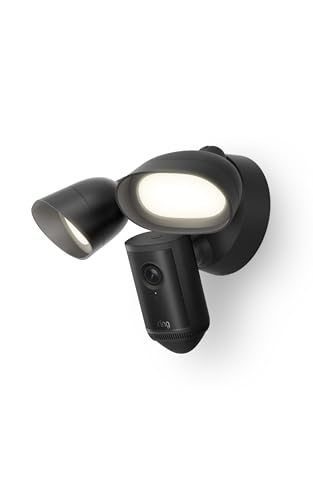
Ring Floodlight Cam 4K Pro: Lights and Camera in One Fixture
A hardwired 4K camera with two 2,000-lumen floodlights and a siren, aimed at driveways where a floodlight is already wired. Smart alerts need a Ring plan.
This is the most direct answer to a dark driveway. Per Ring, the floodlights reach up to 65 feet, the siren is rated at 85 dB, and the camera records 4K video with a 140-by-85-degree view. Because it replaces a floodlight, it puts the light and the lens at the same height and angle. The 3D motion detection and motion zones help you ignore the street.
The catch is the subscription. Ring says person and vehicle detection, extended live view and video search require a compatible Ring plan. Plan on that cost before you rely on alerts. The camera is also physically large, and the floodlights can shine into a neighbor’s window if you do not aim them down. Read our Ring Floodlight Cam 4K Pro profile for the full specifications.
eufyCam S3 Pro 2-Cam Kit: Solar Cameras With Local Storage
Two solar-assisted 4K cameras that store video on a hub in your house with no monthly fee, a good fit when there is no junction box and you do not want to pay for cloud video.
Two cameras let you watch both the garage and the street end of a drive. eufy says recordings go to the HomeBase S380, which has 16 GB built in and takes a drive up to 16 TB, and the page says local storage has no monthly fee. The camera uses radar plus PIR detection and a spotlight, with infrared up to 32.8 feet.
Two limits are worth knowing. The camera records motion events and eufy lists a 24/7 Snapshot feature, not continuous video, and the hub must sit indoors near your router. The camera uses 2.4 GHz Wi-Fi, so it also has to reach that signal. Our eufyCam S3 Pro profile covers solar placement in more detail.
Reolink RLK8-811B4: A Long Driveway or Several Angles
Four wired 4K cameras with 5X optical zoom, spotlights and a recorder with a 2 TB drive, for a long driveway, a gate or a property with several sides to cover.
If the driveway is long, optical zoom is the feature that matters most, and this is the only kit here that has it. Reolink lists 8 MP video, a 5X motorized lens, IP67 cameras and an 8-port PoE recorder that holds about 8 days of footage with four cameras at the default bitrate. It records around the clock locally and says alerts carry no monthly fee.
It is also the most work. Every camera needs a cable back to the recorder, and the recorder needs a hidden, powered spot. In a finished house that may mean an installer. Reolink lists two-way talk only through its app, and it does not list smart-home voice control. See our Reolink RLK8-811B4 profile for the full list.
Google Nest Cam Outdoor: A Short Driveway Near an Outlet
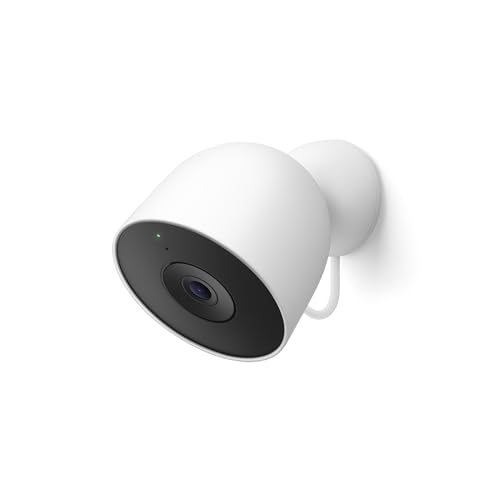
A small plug-in 2K camera for a short driveway or a car parked near the house, especially in a Google Home household. No wiring, but no floodlight either.
Google lists 2K HDR video, a 152-degree diagonal view and night vision up to 20 feet. That makes it a fit for a driveway apron by the garage rather than a long drive. It plugs in with an 18 ft cable and has no battery. Google says video history needs a Google Home Premium plan, while 24/7 live view and short event previews are included. See the Nest Cam Outdoor profile for specifics.
”Security Camera for Car While Parked”: What to Expect
Searches for a camera for a parked car mix two different needs:
- A driveway or garage camera watches the area around your car. It can show someone approaching, a person at the door handle, a car backing in, and a time stamp. A light or siren may discourage them.
- A dash camera records from inside the vehicle. It is the product to look at for parking-lot bumps and street parking, because a driveway camera at home sees nothing when the car is elsewhere. We do not cover dash cameras here.
A driveway camera cannot see through windows, record impacts that happen when the car is away or identify a thief in the dark if they stay outside its range. What it can do is give you footage and a time for an incident report. If your car is parked on the street, a camera mounted at your house may cover it only if the angle and distance allow, and then you are pointing at public space, so keep the view modest.
Privacy: Your Driveway, Not Theirs
Pointing a camera at your own driveway is normal. Pointing it into a neighbor’s windows or yard is how disputes start. A few habits:
- Aim down and in. Frame your own pavement. A little street is unavoidable, but do not capture a neighbor’s front door.
- Use privacy zones and motion zones. Ring lists privacy zones as a feature on the Floodlight Cam 4K Pro.
- Shade or dim lights. A 2,000-lumen floodlight at the wrong angle lights up a bedroom window.
- Think about audio. Federal law is one-party consent, but according to the Reporters Committee for Freedom of the Press about 11 states primarily require everyone’s consent to record conversations. A camera that picks up the sidewalk may record strangers, so consider turning audio off. This is general information, not legal advice.
- Check your HOA and local rules. Some HOAs restrict visible exterior equipment and some cities have rules on lighting.
Which One Fits Your Driveway
- Existing floodlight at the garage: the Ring, if you accept a plan.
- No wiring and no plan: the eufy kit, if there is sun and indoor space for a hub.
- Long drive or several sides: the Reolink system, if you can run cable.
- Short drive and an outlet nearby: the Nest Cam, if you already use Google Home.
Whichever you pick, check the view at dusk and again at night in the first week, adjust the zones and consider a second camera for any gap.
Sources
- Floodlight Cam 4K Pro support and tech specs, Ring
- eufyCam S3 Pro official product page, eufy US
- Reolink RLK8-811B4-A official product page, Reolink
- Nest Cam Outdoor (wired, 2nd gen) specs and features, Google Store
- Best license plate security cameras, Reolink blog
- Introduction to the Reporter’s Recording Guide, Reporters Committee for Freedom of the Press
Frequently asked questions
How far can a security camera see a car in the driveway at night?
It depends on the light and the camera. Ring says the floodlights on its Floodlight Cam 4K Pro reach up to 65 feet. Reolink lists infrared range up to 30 meters (about 98 feet) on its kit cameras, and eufy lists 32.8 feet of infrared on the eufyCam S3 Pro. Seeing that a vehicle is there is easier than identifying a person or a plate at the same distance.
Can a home security camera read a license plate at night?
Usually not reliably. Reolink says general security cameras with strong zoom read plates reliably within roughly 15 to 50 feet, and that plates are retroreflective, so a camera's own infrared light can wash them out. Cars that are moving blur the plate further. Treat a plate as a bonus, not something to plan around.
Floodlight or infrared: which is better for a driveway?
A floodlight gives color video and works as a deterrent, but it can annoy neighbors and attract insects. Infrared is invisible and gentle on neighbors, but the video is black and white and can wash out reflective surfaces. Many cameras in this guide offer both, so you can pick a mode per spot.
Can a driveway camera protect my parked car?
It can record someone walking up to it, which may help with a police report, and a visible light or siren may discourage them. It cannot see inside the car, record impacts away from home or replace a dash camera, which is a different product that mounts inside the vehicle.
Is it legal to point a camera at my own driveway?
Recording your own property in view of the street is generally allowed in the United States, but rules vary by state and city. Avoid aiming at a neighbor's windows or yard, use privacy zones, and consider turning audio off, since state recording laws treat sound differently from video. This is general information, not legal advice.
Do I need an electrician to install a driveway camera?
Only for hardwired models without an existing fixture. Ring says installation by a qualified electrician may be required in your area for its Floodlight Cam. Solar and battery cameras, or a plug-in model near an outlet, avoid that, and PoE systems need Ethernet cable runs instead.