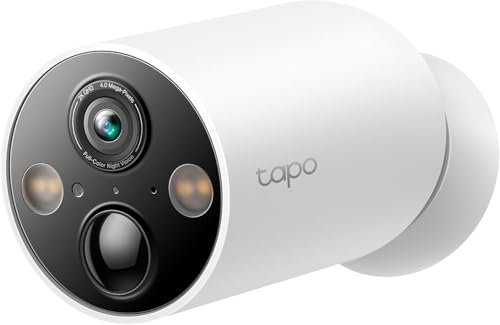
The TP-Link Tapo C425, sold as the Tapo MagCam, is a battery-powered 2K security camera built for outdoor use. It connects straight to your Wi-Fi, so there is no hub to buy, and it records to a microSD card that you add yourself. In our ranking it sits among the budget picks, which is why it appears in our best security cameras of 2026 comparison next to far more expensive systems.
We write from published specifications, not our own measurements. Every figure below is attributed to Tapo (TP-Link), and where Tapo’s pages disagree or stay silent, we say so.
The Short Version
According to Tapo, the C425 offers 2560 x 1440 live view, color night vision from built-in spotlights and a starlight sensor, an IP66 weatherproof rating, a built-in rechargeable lithium-ion battery and an adjustable magnetic base. AI detection of people, pets and vehicles is listed as free, with custom activity zones. Cloud storage is the only thing that requires a paid plan, called Tapo Care.
That mix is the whole pitch: a wire-free outdoor camera where the everyday features do not sit behind a monthly fee. The trade-offs are 2.4 GHz-only Wi-Fi, a card you have to buy separately and a battery whose real life depends heavily on how much happens in front of the lens.
Key Specs According to Tapo
- Video: 2K QHD, 2560 x 1440, with live view in the Tapo app.
- Field of view: 142 degrees diagonal, 122 degrees horizontal and 66 degrees vertical, per the Tapo specifications page. Some U.S. marketing rounds this to 150 degrees, so treat 142 as the figure to plan around.
- Night vision: Full-color night vision using built-in spotlights and a starlight sensor, plus infrared with about a 49 ft (15 m) range using an 850 nm IR LED.
- Weather rating: IP66. Tapo’s footnote says the rating applies to the camera itself.
- Operating temperature: -4°F to 113°F (-20°C to 45°C), according to Tapo.
- Power: Built-in rechargeable lithium-ion battery. Tapo claims up to 300 days per charge under lab conditions.
- Size: 4.57 x 2.55 x 2.55 in (116.2 x 64.8 x 64.8 mm).
- Wi-Fi: 2.4 GHz only, IEEE 802.11b/g/n.
- Storage: microSD up to 512 GB, or cloud storage with a Tapo Care subscription.
- Mounting: Adjustable magnetic base.
- Solar: Optional Tapo solar panel, sold separately.
Tapo does not list the weight on the pages we opened, so we leave it out.
What Works Without a Subscription
This is where the C425 stands out against the big-name wire-free cameras. According to Tapo, these are available without paying anything:
- Live view and the 2K video stream in the Tapo app.
- AI detection that tells people, pets and vehicles apart, plus custom activity zones.
- Recording to a microSD card you supply.
- Color night vision and the built-in spotlights.
What you pay for is cloud storage. Tapo’s footnote says to subscribe to Tapo Care for cloud storage. That matters if you worry about a thief taking the camera, because a card inside the camera leaves with it. Tapo lists anti-theft alerts and a password lock for the card, which helps protect your footage but does not bring the camera back. If off-site copies are a priority, either budget for Tapo Care or choose a system with a base station that stores video indoors, such as a hub-based kit.
Battery Life: Read the Fine Print
Tapo’s headline figure is up to 300 days of uninterrupted performance on a single charge. The footnote is the important part: that number comes from Tapo’s lab, at 230 seconds of use per day. At 360 seconds per day, Tapo says the battery lasts 180 days. In other words, Tapo itself shows how fast the figure falls as activity rises.
Consider where you mount it. A camera over a quiet side door might trigger a few times a day. A camera facing a street, a shared driveway or a tree that moves in the wind will wake constantly, record more clips and run the battery down faster. Activity zones and a sensitivity setting that matches the scene help, but expect to recharge more often than once or twice a year in a busy location.
The optional solar panel is the answer for hard-to-reach spots. Tapo’s page says the camera works with the Tapo A201 panel, sold separately. Other regional pages name different models, so confirm which panel matches this camera before you buy one.
Installation and Mounting
There is no wiring and no hub. According to Tapo, the C425 uses an adjustable magnetic base. You fix the base to a wall, post or eave with the supplied hardware, and the camera snaps on. The magnet makes it easy to pull the camera off for charging and click it back at the angle you want.
For renters, the appeal is obvious: no cable through a wall and no outlet near the door. Still, a base that screws into a wall is a modification, so read your lease. If the lease forbids drilling, a camera placed on a shelf or ledge inside your own balcony or porch is an option, and the magnet lets you reposition it easily. Aim it at your own door or space. Pointing a camera at a neighbor’s window or a shared hallway can cause trouble with a landlord or with privacy laws, and some states restrict recording audio of people who do not know about it.
Wi-Fi and Smart-Home Support
The camera joins 2.4 GHz networks only. That band reaches farther than 5 GHz, which suits an outdoor device, but it is also more crowded and slower. If the signal at your door is weak, the Tapo app will usually show it during setup. A mesh node or an outdoor-rated extender closer to the camera is cheaper than fighting dropped connections.
On smart-home support, Tapo’s footnote says the C425 is compatible with Alexa and Google Assistant supported displays. That means you can ask a screen such as an Echo Show or a Nest Hub to show the live view. Tapo’s page does not list Apple Home on the pages we opened, so do not count on it.
Day and Night Video
Tapo advertises 2K video with a 142-degree field of view. In practice, that is enough to cover a front porch and part of a walkway, but it will not take in a whole yard from a distance. Color night vision uses the built-in spotlights, which light the scene when the camera detects something, while the 850 nm infrared LEDs give a black-and-white fallback out to about 49 ft. Color at night depends on the lights, so a camera aimed at a dark yard far from the house will show less color than one covering a porch.
The starlight sensor is there to gather more light before the spotlights come on. We have no measured data on how it looks at night, and Tapo gives no lux figure, so we make no claim beyond what Tapo says.
Who It Is For
- Budget buyers who want a wire-free outdoor camera with AI detection and local storage and do not want a recurring fee.
- Renters and condo owners who cannot run cable and want a camera that moves easily.
- Homeowners adding a second angle such as a side gate or garage door, where a plug-in camera is awkward.
- People comfortable with a microSD card as the main recording method.
Who Should Skip It
- Anyone who wants off-site video without paying. The card lives inside the camera. If it is stolen, so is the footage, unless you pay for Tapo Care.
- Households on 5 GHz-only Wi-Fi or with a weak signal at the mounting spot.
- Apple Home users, since Tapo’s page does not list support.
- Buyers who want a floodlight, siren or radar-based detection. Those need a different class of camera.
- Anyone who wants to forget about charging. A wire-free camera always needs a plan for the battery.
How It Compares With Its Neighbors
If you want a plug-in camera with no battery to manage, the Tapo C120 uses the same app, the same microSD ceiling and a USB-C power cable. If you want a very small camera for an apartment shelf or window, the Wyze Cam v4 is also wired and records to a card, but its card limit is lower. The C425’s advantage is that it is the only one of the three built to run on its own battery.
The Bottom Line
The Tapo C425 is a sensible pick when the priorities are no hub, no required plan and a camera you can place almost anywhere with a magnet. It keeps AI detection free, stores video on your own card and leaves cloud storage as an option. Know its limits: 2.4 GHz Wi-Fi only, a card you must buy and a battery claim that depends on activity. If those fit, it is one of the most flexible entry-level outdoor cameras in our lineup.
To check the current listing and see the price, go to Tapo C425 on Amazon.
Sources